The Noise Curfew Is Not the End of the Party: How a 3-Channel Silent Disco Saves Your Eastern Shore Wedding Night
Maryland's Eastern Shore venues are stunning — and they come with strict 10 PM noise curfews. Here's how a 3-channel silent disco transforms that limitation into the most talked-about moment of your entire wedding.
You found the perfect venue. Maybe it's Silver Swan Bayside with its jaw-dropping waterfront views, or Kent Island Resort with its sprawling farmstead charm, or one of the dozens of breathtaking properties tucked along the Chesapeake Bay and Eastern Shore. You've been dreaming about this place. And then your venue coordinator drops the news: music must stop at 10 PM.
I've watched couples' faces fall when they hear that. I get it. You've got 150 people who just hit their stride on the dance floor, the energy is electric, and suddenly you're supposed to just... stop? That's not a party. That's a curfew.
Here's what I tell every couple I work with on the Eastern Shore: the noise curfew is not the end of your party. It's the beginning of the best part. And the tool that makes it possible is a 3-channel silent disco — and when it's done right, it becomes the single most talked-about moment of your entire wedding night.
Why Eastern Shore Venues Have Strict Curfews (And Why That's Not Going Away)
Let's be real about the landscape. Maryland's Eastern Shore counties — Talbot, Queen Anne's, Dorchester — are a mix of residential communities, agricultural land, and protected waterfront ecosystems. The venues you love are often situated in areas where neighbors are close enough to hear a bass line at 10:30 PM. Local noise ordinances aren't suggestions; they're enforced, and venues that violate them risk losing their event licenses.
Venues like Silver Swan Bayside, Herrington on the Bay, and waterfront properties throughout the Chesapeake Bay region typically enforce 10 PM or 11 PM outdoor amplified music cutoffs. Some allow indoor music to continue later, but many don't have the indoor capacity to move a full reception. This is the reality of marrying in one of the most beautiful regions on the East Coast — and it's a trade-off most couples are absolutely willing to make.
What they're not willing to do is let the party die at 10 PM. And they shouldn't have to.
What Is a 3-Channel Silent Disco — And Why Does It Work So Well?
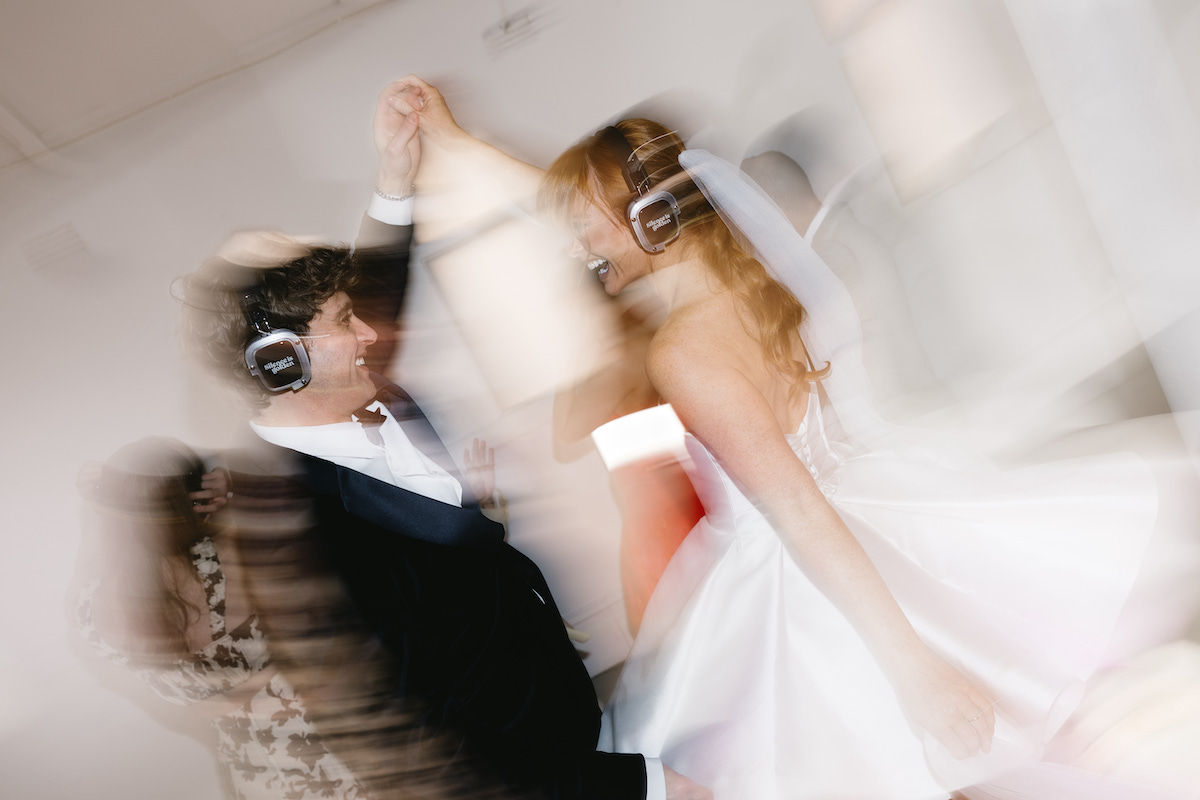
A silent disco is exactly what it sounds like: guests wear wireless LED headphones, and the music plays directly into their ears instead of through speakers. From the outside, it looks like a room full of people dancing to nothing — which is genuinely hilarious and also kind of magical. From the inside, wearing those headphones, it's a full concert experience.
The 3-channel format is where it gets really interesting. Instead of one music stream, I run three simultaneous channels — each one a different genre or vibe. Guests can flip between channels with a button on their headset, and the LED light on their headphones changes color to show which channel they're on. So you can literally look across the dance floor and see who's on the throwbacks channel (blue lights), who's on the hip-hop channel (red lights), and who's on the house/pop channel (green lights).
"I've done silent discos at venues from Silver Swan Bayside to private estates on the Eastern Shore, and without fail, the crowd that stays for the silent disco is the crowd that's still talking about it at brunch the next morning. It's not a consolation prize — it's the headliner."
Here's a sample 3-channel setup I love for Eastern Shore weddings:
- Channel 1 (Blue): 80s, 90s & 2000s Throwbacks. The crowd-pleaser. Your parents, your college friends, your aunt who's been waiting all night for "Don't Stop Believin'" — this channel is for them.
- Channel 2 (Red): Hip-Hop & R&B. From Kendrick to Beyoncé to classic Jay-Z. The channel that keeps the energy high and the dance floor moving.
- Channel 3 (Green): Modern Pop & House. Current hits, feel-good anthems, and the kind of driving beats that make you forget you've been dancing for three hours.
The beauty of this format is that nobody is stuck with music they don't love. Your 65-year-old uncle and your 25-year-old cousin can be on the same dance floor, both having the time of their lives, on completely different channels. That's not something a traditional DJ setup can do.
How to Structure Your Night Around the Silent Disco
The key to making a silent disco feel premium — not like a last-minute workaround — is how you build up to it. Here's the timeline structure I recommend for Eastern Shore weddings with a 10 PM outdoor curfew:
- 5:00–6:00 PM — Cocktail Hour. Acoustic or jazz-influenced background music. Guests arrive, drinks flow, the waterfront views do the heavy lifting.
- 6:00–7:00 PM — Dinner. Curated dinner music that builds from elegant to slightly more upbeat as the meal progresses. This is where I start reading the room.
- 7:00–9:45 PM — Main Reception & Dancing. This is your full-energy, traditional DJ set. Toasts, first dances, parent dances, open dancing. I build the energy deliberately so that by 9:30 PM, the dance floor is absolutely on fire.
- 9:45 PM — The Transition Announcement. I make a big deal of this. "Ladies and gentlemen, in 15 minutes we're going to do something you've never experienced at a wedding before..." The anticipation is part of the experience.
- 10:00 PM — Silent Disco Begins. Headsets go on, the outdoor speakers go off, and the party continues. No interruption. No energy drop. Just a shift in format that feels like an upgrade.
- 10:00 PM–Midnight (or later) — Silent Disco After-Party. The remaining crowd — always the most enthusiastic guests — dances until they physically can't anymore.
The Silent Disco Logistics You Need to Know
Before you add this to your wedding plan, here are the practical details:
- Headset rental cost: Typically $6–$7 per headset, plus $75–$100 per transmitter. For 100 guests, budget $700–$800 for equipment rental on top of your DJ package.
- You need a headset attendant: Someone dedicated to distributing, collecting, and sanitizing headsets throughout the night. This is non-negotiable for a smooth experience.
- Venue approval: Always confirm with your venue coordinator that a silent disco is permitted. Most Eastern Shore venues love it — it solves their curfew problem too.
- Headset count: Order 10–15% more headsets than your expected late-night guest count. You don't want to run out.
The Venues Where I've Seen This Work Best
I've executed silent disco after-parties at waterfront venues across Maryland and the Eastern Shore, and certain venue types are particularly well-suited for this format. Open-air pavilions and outdoor tent receptions are ideal — the visual of a crowd dancing in silence under the stars, LED headsets glowing in the dark, is genuinely stunning. It photographs beautifully and creates a moment that guests will screenshot and share for years.
Silver Swan Bayside on the Chesapeake Bay is one of my favorite venues for this setup. The waterfront backdrop at night, combined with the glow of the headsets, creates an atmosphere that feels like something out of a movie. Kent Island Resort works beautifully too — the transition from the main reception space to an outdoor silent disco under the stars is seamless when planned correctly.
Even venues with indoor options benefit from the silent disco format. If your venue allows indoor music past 10 PM but the space is smaller than your main reception room, the silent disco lets you keep the full crowd engaged without worrying about sound bleed or neighbor complaints.
The Moment That Makes It All Worth It
Here's what I want you to picture: It's 10:05 PM. The outdoor speakers have gone quiet. Your venue coordinator is relieved. And then 80 of your closest friends and family put on glowing headphones and absolutely lose their minds on the dance floor — in near-total silence — for the next two hours.
People walking by outside see a crowd dancing to nothing. They stop. They stare. They laugh. Some of them ask if they can join. Your wedding has become a spectacle in the best possible way.
Inside those headphones, the music is perfect. The bass hits exactly right. The crowd is singing along. Your best friend is on Channel 1 belting out "Mr. Brightside" while your cousin on Channel 2 is losing it to "HUMBLE." And somehow, impossibly, you're all on the same dance floor having the same incredible night.
That's not a workaround. That's a wedding moment.
Is a Silent Disco Right for Your Wedding?
Not every wedding needs a silent disco — but if you're getting married at a waterfront or outdoor venue on the Eastern Shore, Chesapeake Bay, or anywhere in Maryland with a noise curfew, it's worth a serious conversation. The couples who do it never regret it. The couples who don't sometimes wish they had.
If you want to explore whether a silent disco makes sense for your venue and guest count, I'd love to talk through the logistics with you. I've done this enough times to know exactly what works, what doesn't, and how to make it feel like a premium experience rather than a Plan B.
You can also take the "What's Your Wedding Vibe?" quiz to get a sense of what entertainment format fits your style, or download the free Wedding Entertainment Planning Guide — it covers everything from timeline planning to entertainment add-ons like silent discos, cold sparks, and more.
Ready to talk? Call me at (901) 459-9527 or shoot an email to [email protected]. Let's make sure your Eastern Shore wedding night doesn't end at 10 PM — it just gets better.
With love & beats,
DJ Chris Luciano
Maryland's Wedding Dance Floor Architect
Free Wedding Entertainment Guide
Get the complete planning playbook — timelines, playlists, hiring tips, and red flags from 20+ years and 500+ weddings.
Download Free GuideWhat's Your Wedding Vibe?
Take our 60-second quiz and get personalized music recommendations for your big day.
Take the QuizReady to Start Planning?
Let's discuss your wedding vision and check availability for your date. No pressure — just a conversation about making your day unforgettable.